



Air Filter Classes Explained: EN ISO 16890 and EN 1822 Guide
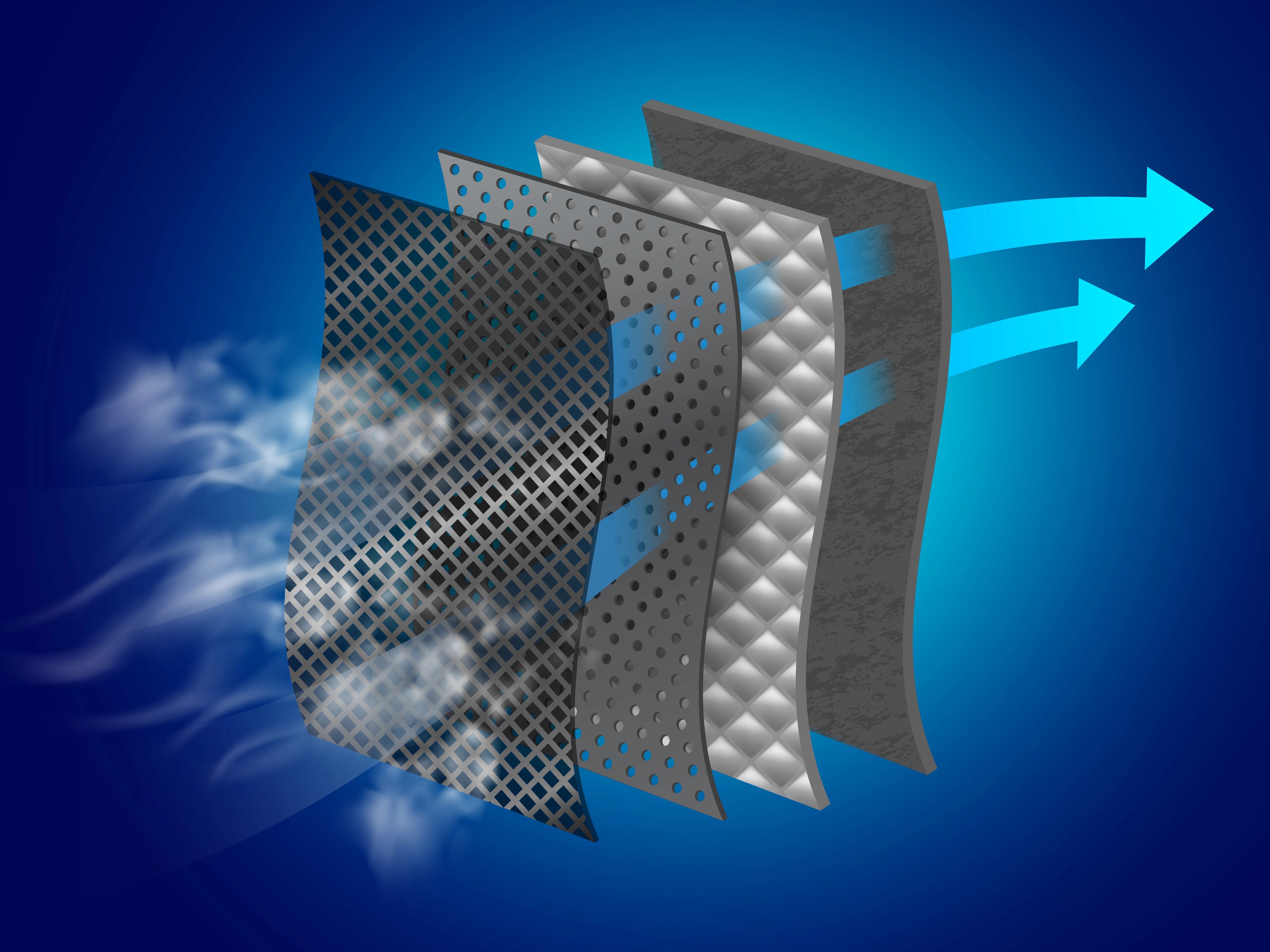
An air filter class is a standardised performance label that shows what proportion of airborne particles a filter captures under controlled laboratory testing. General ventilation filters are classified under EN ISO 16890 into ISO Coarse, ISO ePM10, ISO ePM2.5 and ISO ePM1 groups, while HEPA and ULPA filters are classified under EN 1822 from E10 up to U17. The former EN 779 codes such as G3, G4, M5, F7 and F9 were withdrawn in 2018.
This guide explains both standards, the class tables, the approximate equivalents of the old codes, and which class to specify for each application, supported by measurable data.
What Is a Filter Class and Why Does It Matter?
A filter class gives a comparable performance measure that is independent of brand or physical appearance. An ISO ePM1 60% bag filter from any manufacturer captures at least 50% to 65% of particles smaller than 1 micron under the same test conditions. Without a class designation, the phrase "high efficiency filter" carries no technical meaning.
Choosing the correct class delivers three outcomes at once:
- The targeted indoor air quality is genuinely achieved
- Fan energy is not wasted
- Replacement intervals and operating costs become predictable
Why Was EN 779 Withdrawn and What Does ISO 16890 Change?
EN 779:2012 relied on synthetic dust and a single reference particle diameter of 0.4 micron. This method did not reflect real atmospheric performance, and synthetic electrostatically charged media in particular showed a significant gap between laboratory results and field behaviour.
The EN ISO 16890 series replaced EN 779:2012 in August 2018. Its key difference is that filters are rated directly against the PM values used in public health literature. PM1, PM2.5 and PM10 refer to the mass of particles below 1, 2.5 and 10 microns respectively, which are the same units used in air pollution monitoring and respiratory health research.
In the ISO 16890 test, the filter is measured across a wide particle range from 0.3 to 10 microns, and results are reported separately for each PM fraction. To be assigned to a group, the filter must reach at least 50% efficiency in that fraction, and the reported value is rounded to the nearest 5%.
EN ISO 16890 Filter Groups
| ISO 16890 Group | Measured Fraction | Entry Condition | Typical Use |
|---|---|---|---|
| ISO Coarse | Gravimetric arrestance | ePM10 efficiency below 50% | Pre-filtration, coarse dust |
| ISO ePM10 | Particles below 10 micron | ePM10 efficiency 50% or above | Pre and secondary stage, pollen |
| ISO ePM2.5 | Particles below 2.5 micron | ePM2.5 efficiency 50% or above | Secondary stage, commercial buildings |
| ISO ePM1 | Particles below 1 micron | ePM1 efficiency 50% or above | Fine stage, hospitals, HEPA protection |
Correct notation example: ISO ePM1 65%, meaning the filter captures approximately 65% of particles below 1 micron.
Approximate ISO 16890 Equivalents of Old EN 779 Classes
Important caveat: because the two standards use different test methods, no exact mathematical conversion exists. The table below shows the approximate equivalents widely accepted in the field. For a firm specification, always request the ISO 16890 test report.
| Old Class (EN 779) | Approximate ISO 16890 Equivalent | Filter Type |
|---|---|---|
| G3 | ISO Coarse 45-60% | Roll and cassette filter |
| G4 | ISO Coarse 60-90% | Cassette, panel and roll filter |
| M5 | ISO ePM10 50-65% | Bag filter |
| M6 | ISO ePM2.5 50-65% | Bag and compact filter |
| F7 | ISO ePM1 50-65% | Bag and compact filter |
| F8 | ISO ePM1 65-80% | Bag and compact filter |
| F9 | ISO ePM1 80-90% | Bag and compact filter |
You can review the corresponding products in our range on the G3 and G4 bag filters and M5 to F9 bag filters pages.
EN 1822: HEPA and ULPA Filter Classes
ISO 16890 does not cover filters above ePM1 95%. Beyond that point, EN 1822 applies. EN 1822 tests the filter under the most demanding condition, namely at MPPS.
What Is MPPS?
MPPS (Most Penetrating Particle Size) is the particle size at which a filter shows its lowest efficiency, typically between 0.1 and 0.25 micron for glass fibre HEPA media. Larger particles are captured by impaction and interception, smaller ones by diffusion. If a filter meets a given efficiency at MPPS, it performs better at every other size.
| Class | Overall Efficiency (MPPS) | Local Efficiency | Typical Application |
|---|---|---|---|
| E10 | 85% | Not defined | Protective stage, EPA group |
| E11 | 95% | Not defined | Fine stage, compact filter |
| E12 | 99.5% | Not defined | Fine stage |
| H13 | 99.95% | 99.75% | Hospitals, operating theatres, cleanrooms |
| H14 | 99.995% | 99.975% | ISO 5 cleanrooms, GMP Grade A and B |
| U15 | 99.9995% | 99.9975% | Microelectronics, ULPA group |
| U16 | 99.99995% | 99.99975% | Semiconductor manufacturing |
| U17 | 99.999995% | 99.9999% | Highest purity processes |
A critical distinction: E10, E11 and E12 are not HEPA filters. They belong to the EPA (Efficient Particulate Air) group and are not required to undergo individual leak scanning. True HEPA begins at H13, where every single unit must be individually tested and certified with a serial number. See our HEPA filter range for available options.
Which Filter Class for Which Application?
| Application | Pre Stage | Secondary Stage | Final Stage |
|---|---|---|---|
| Office and business centre | ISO Coarse 60% | ISO ePM1 50-60% | Not required |
| Shopping mall and hotel | ISO Coarse 60% | ISO ePM1 60-70% | Activated carbon if odour |
| Hospital general areas | ISO ePM10 60% | ISO ePM1 80% | H13 |
| Operating theatre | ISO ePM10 60% | ISO ePM1 80-90% | H14 |
| Pharmaceutical (GMP A/B) | ISO ePM10 60% | ISO ePM1 80% | H14 |
| Electronics and optics | ISO ePM10 60% | ISO ePM1 85% | H14 or U15 |
| Food production | ISO Coarse 85% | ISO ePM1 70% | H13 in critical zones |
For sector specific solutions see filters used in hospitals, filters used in pharmaceutical production facilities and filters used in clean rooms.
Four Common Mistakes in Filter Class Selection
1. Specifying a class that is too high
Installing an ISO ePM1 filter at the pre-filter stage causes rapid clogging and an early rise in pressure drop. A higher class is not always better; a staged arrangement is far more efficient.
2. Omitting the pre-filter
An H13 HEPA filter running without pre-filtration may need replacing before reaching even a third of its normal service life. HEPA media is not designed to capture coarse dust.
3. Looking only at purchase price
Most of a filter total cost is not its purchase price but the fan energy it consumes over its life. A filter with a lower initial pressure drop is more economical annually, even at a slightly higher unit price.
4. Ignoring frame and gasket quality
A filter with H14 media that leaks at its frame can deliver effective system performance no better than H10. Sealing matters as much as the class itself.
Frequently Asked Questions
What ISO class does an F7 filter correspond to?
An F7 filter corresponds approximately to ISO ePM1 50-65% under EN ISO 16890. The conversion is approximate because the two standards use different test methods, so no exact match exists. Always check the ePM1 value in the filter ISO 16890 test report.
What is the difference between H13 and H14?
An H13 filter delivers at least 99.95% efficiency at MPPS, while H14 delivers at least 99.995%. H14 therefore allows ten times fewer particles through, and is specified for operating theatres, GMP Grade A and B areas and ISO 5 cleanrooms.
Is EN 779 still valid?
No. EN 779:2012 was withdrawn in August 2018 and replaced by the EN ISO 16890 series. Although codes such as G4, M5 and F7 are still used out of habit, new projects should be specified using ISO 16890 classification.
What is the difference between ISO Coarse and ISO ePM10?
An ISO ePM10 filter captures at least 50% of particles below 10 microns and is rated by efficiency percentage. ISO Coarse filters fall below that threshold and are reported by gravimetric arrestance, that is the mass of dust they retain.
Does an E11 filter count as HEPA?
No. E11 belongs to the EPA group under EN 1822 with an overall efficiency of 95%. HEPA classification starts at H13. E class filters are not required to undergo individual leak scanning, whereas H class filters are.
Let Us Determine the Right Class for Your Project
Filter class selection must account for particle load, air volume, existing air handling unit capacity and the target cleanliness class together. At Safe Air Filtration we manufacture every stage from pre-filters to ULPA in our own facility and provide project specific custom sizes. Browse our full range on the products page or contact us for technical support.

Is HEPA Filter Washable With Water


