



Cleanroom Filtration: ISO 14644 and GMP Classes Explained
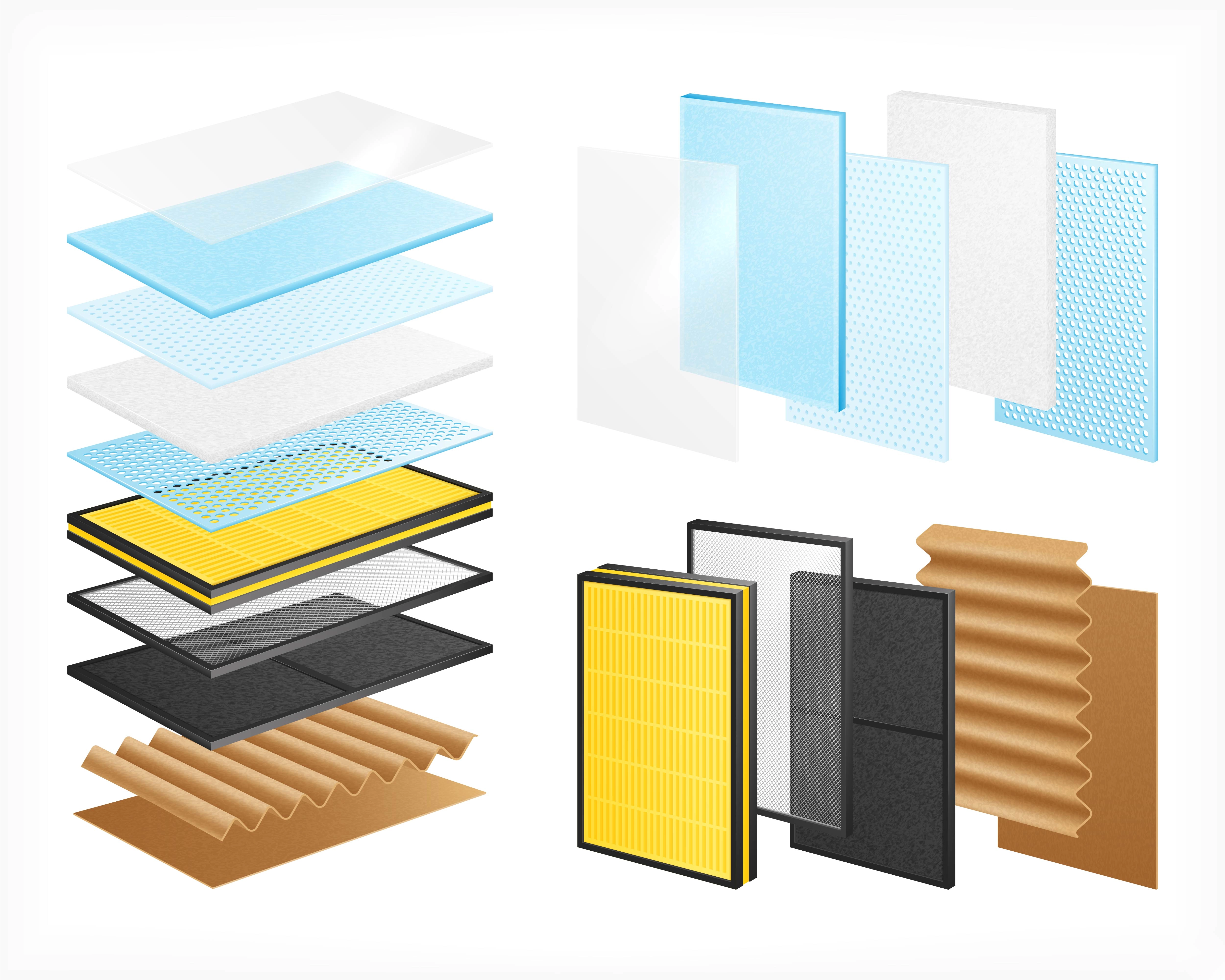
A cleanroom is an enclosed production or process space in which airborne particle counts are held below a defined limit while temperature, humidity and pressure differentials are controlled. Cleanliness is classified from ISO 1 to ISO 9 under ISO 14644-1, while pharmaceutical manufacturing uses Grades A, B, C and D under GMP Annex 1. In every one of these classes, the element that actually delivers the cleanliness is the H13 or H14 HEPA filter installed at the room inlet.
This article sets out the class tables, air change rate requirements, GMP equivalents and the correct filter arrangement for each class.
ISO 14644-1 Cleanroom Classes
ISO 14644-1 defines the maximum permitted particle count per cubic metre of air by particle size. The table below gives the limits for the most commonly used sizes.
| ISO Class | ≥0.5 µm (particles/m³) | ≥5.0 µm (particles/m³) | Typical Use |
|---|---|---|---|
| ISO 5 | 3,520 | Not defined | Sterile filling, aseptic processing |
| ISO 6 | 35,200 | 293 | Surrounding sterile areas, optics |
| ISO 7 | 352,000 | 2,930 | Pharmaceutical preparation, medical devices |
| ISO 8 | 3,520,000 | 29,300 | Packaging, support areas |
| ISO 9 | 35,200,000 | 293,000 | Normal room air level |
Each class step represents a tenfold change in the particle limit. An ISO 7 room therefore contains ten times fewer particles than an ISO 8 room, which substantially raises both the filtration and air change requirements.
GMP Grades and Their ISO 14644 Equivalents
GMP Annex 1 defines four grades for pharmaceutical and sterile product manufacturing. Unlike ISO 14644, GMP requires measurement in two distinct states: at rest and in operation.
| GMP Grade | At Rest | In Operation | Required Final Filter |
|---|---|---|---|
| A | ISO 5 | ISO 5 | H14, unidirectional flow |
| B | ISO 5 | ISO 7 | H14 |
| C | ISO 7 | ISO 8 | H13 or H14 |
| D | ISO 8 | Not defined | H13 |
Grade A areas are the critical zones where sterile product is exposed, and unidirectional (laminar) airflow is mandatory there, with a typical velocity of 0.36 to 0.54 m/s. See our filters used in pharmaceutical production facilities page for the solutions we supply.
Air Change Rate (ACH) Requirements
The second element that maintains a cleanroom class is how many times per hour the room volume is replaced with clean air, expressed as the air change rate or ACH.
| Cleanliness Class | Typical Air Change Rate | Flow Type |
|---|---|---|
| ISO 5 / GMP A | 240-600 or unidirectional flow | Unidirectional (laminar) |
| ISO 6 | 70-160 | Mixed flow |
| ISO 7 / GMP B-C | 30-60 | Mixed flow |
| ISO 8 / GMP D | 10-25 | Mixed flow |
Why these numbers matter: designing an ISO 7 room at 40 ACH, with a floor area of 100 m² and a height of 3 m, requires circulating roughly 12,000 m³ of air per hour. All of that volume passes through HEPA filters, so filter area, pressure drop and air handling unit capacity must be planned together.
Cleanroom Filter Arrangement
Cleanrooms are normally built around three or four filtration stages:
- Stage 1: ISO Coarse 60-90% pre-filter at the fresh air intake
- Stage 2: ISO ePM1 70-85% fine filter inside the air handling unit
- Stage 3: Activated carbon where there is a gas or odour load
- Stage 4: H13 or H14 HEPA in terminal position at the room inlet
The HEPA stage must be at the room inlet. A HEPA filter left inside the air handling unit provides no protection against particles shed from downstream duct surfaces. Terminal installation uses HEPA boxes, fan filter units (FFU) and hooded HEPA filters.
Why Gel Seal Frames Are Preferred
In cleanrooms, the seal between filter and housing is as critical as the filter efficiency itself. Two methods are used:
- Gasket type: compression against a polyurethane or neoprene gasket. Economical and sufficient for ISO 7 and ISO 8 areas.
- Gel seal: gel filling the frame channel seats onto a knife edge profile in the housing, forming a continuous and fully leak free line. Preferred in ISO 5 and GMP Grade A and B areas.
See our HEPA filter range for gel seal options.
Pressure Cascade and Flow Direction
Cleanroom filtration is not only about filter selection; the pressure differential between rooms is equally decisive in maintaining class. The general rule is that air must flow from cleaner to less clean areas.
- Typical differential between adjacent classes is 10 to 15 Pa
- The cascade is maintained stepwise through airlocks around sterile areas
- Where toxic or biological risk exists, flow direction is reversed and the room is held at negative pressure
If the pressure cascade is lost, contaminated air enters the room on every door opening regardless of how good the HEPA filter is. See our filters used in clean rooms page for application details.
Commissioning and Periodic Test Requirements
A cleanroom class is proven by measurement, not by design alone. Tests performed under ISO 14644-3 include:
| Test | Purpose | Typical Interval |
|---|---|---|
| Airflow and ACH measurement | Verify design airflow is achieved | 6-12 months |
| HEPA leak (DOP/PAO) scan | Detect filter and frame leaks | 6-12 months |
| Particle counting | Verify ISO or GMP class | 6-12 months |
| Pressure differential measurement | Verify the cascade | Continuous monitoring |
| Recovery test | Rate of return after contamination | 12-24 months |
We cover how leak scanning is performed in detail in our article on HEPA filter DOP/PAO testing and leak testing.
Frequently Asked Questions
What are the cleanroom classes?
Under ISO 14644-1 cleanrooms are classified from ISO 1 to ISO 9, with ISO 5, 6, 7 and 8 the most commonly used. Pharmaceutical manufacturing additionally uses GMP Grades A, B, C and D; Grade A corresponds to ISO 5, while Grade D corresponds to ISO 8 at rest.
Which HEPA filter class is used in a cleanroom?
H13 is used in ISO 8 and GMP D areas, H13 or H14 in ISO 7 and GMP C areas, and H14 in ISO 5 and GMP Grade A and B areas. Classes cleaner than ISO 5, such as semiconductor and microelectronics production, require U15 or higher ULPA filters.
What ISO 14644 class does GMP Grade A correspond to?
GMP Grade A corresponds to ISO 5 both at rest and in operation. Unidirectional laminar airflow is mandatory in these areas, with a typical velocity of 0.36 to 0.54 m/s.
What air change rate does a cleanroom need?
ISO 8 and GMP D areas use 10-25 air changes per hour, ISO 7 and GMP B-C areas 30-60, and ISO 6 areas 70-160. ISO 5 and GMP A areas use unidirectional flow rather than mixed flow, where velocity rather than ACH is the governing criterion.
Where in the cleanroom is the HEPA filter installed?
At the room inlet, in terminal position. A HEPA filter left inside the air handling unit cannot capture particles shed from downstream duct surfaces, so it must be mounted in a HEPA box, fan filter unit or ceiling diffuser housing.
We Support Your Cleanroom Project
At Safe Air Filtration we manufacture every stage from pre-filters to ULPA in our own facility and produce HEPA filters in project specific sizes with both gel seal and gasket frame options. For class determination, filter arrangement and test planning, contact us or browse our full range on the products page.

How do filter systems work


